
Nothing Matters By Default
When Nothing Is Inherently Right

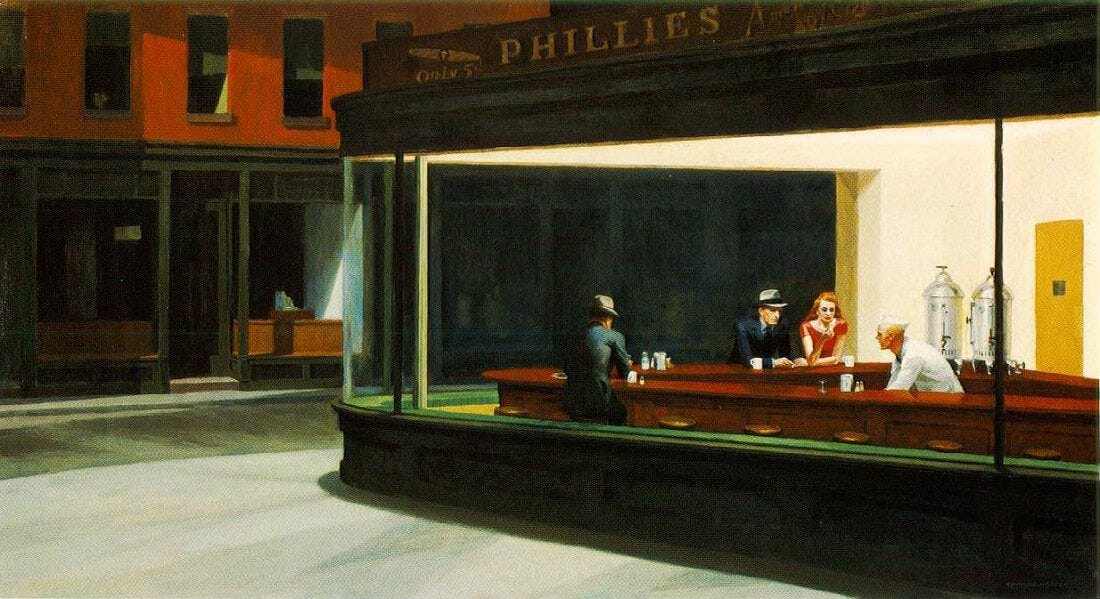
In a brightly lit diner at 2 a.m., nothing outside the glass cares that they are kind to each other.
What if I am wrong about everything
I was taught to call right?
I no longer know
where to stand.
When someone says, “This is good,”
what are they pointing at?
A law?
A feeling?
A consensus rehearsed so often
it hardened into certainty?
I try to locate it.
Is good a substance?
Does it exist somewhere
untouched by opinion?
If every human vanished tonight,
would kindness still be kind
in an empty universe?
Or would it dissolve
like a word
with no mouth left to speak it?
I was told morality stands above us.
Steady. Objective. Permanent.
A mountain.
But I have watched it bend.
Watched violence condemned
then justified.
Watched truth defended
then edited.
Watched fairness praised
until it threatened comfort.
Watched loyalty celebrated
until it concealed rot.
Watched freedom worshipped
until it destabilized power.
Watched compassion applauded
until it demanded sacrifice.
So I ask again:
Is morality discovered,
or negotiated?
If it is discovered,
why does it look different
across borders?
Across centuries?
Across dinner tables?
If it is negotiated,
who writes the terms?
And who signs
without reading?
What if there is no moral fabric?
No invisible thread
we are betraying
when we act cruelly?
What if “wrong”
is not a cosmic violation,
but a human agreement
shattered?
This thought feels dangerous.
Because if nothing is inherently wrong,
then what stops us?
Law.
Fear.
Reputation.
Love.
Empathy.
Shame.
Desire for belonging.
Are these anchors strong enough?
Or are they simply
social gravity
holding us in orbit
as long as we agree
not to drift?
Are we moral
or merely coordinated?
If morality were absolute,
would it need reinforcement?
Would it require prisons,
policies,
rituals,
education systems,
oaths spoken over books,
public humiliation as theater?
Or would it simply persist
without maintenance?
The more I look,
the more morality resembles architecture.
Designed to channel behavior.
Engineered to minimize damage.
Decorated with sacred language
to ensure loyalty.
Sometimes it is elegant.
Sometimes oppressive.
Sometimes both at once.
Remove agreement,
and it weakens.
Remove enforcement,
and it collapses.
Remove belief,
and it becomes ornamental.
This does not mean
nothing matters.
It means nothing matters
by default.
Kindness is not inevitable.
Justice is not guaranteed.
Dignity is not embedded
in the atoms of existence.
They are constructions.
Sustained by education.
Protected by law.
Reinforced by culture.
Modeled by leaders.
Demanded by citizens.
Defended by those
willing to lose something
for them.
If everyone stopped believing
in fairness tomorrow,
would fairness survive?
Or would it decay
like a language no one speaks
until even the memory of it
sounds foreign?
The universe would remain indifferent.
No thunder
for betrayal.
No eclipse
for cruelty.
No celestial correction
when harm outweighs care.
Only aftermath.
Only systems responding to pressure.
Only human bodies
absorbing the results
of human choices.
There is something stark in this.
Not liberation per say.
Exposure.
If there is no objective good,
then every act of goodness
is chosen without guarantee.
Chosen without applause.
Chosen without metaphysical reward.
If there is no absolute evil,
then every refusal to harm
is restraint
without supervision.
Ethical nihilism might not be
the destruction of morality.
It might be the removal
of its training wheels.
No divine referee.
No ultimate script.
No promised ending
where justice restores itself
because it deserves to.
Only us.
Inventing meaning.
Testing it.
Failing it.
Repairing it.
Arguing over it.
Protecting it
when it becomes fragile.
Maybe the beauty is not
that morality exists beyond us.
Maybe the beauty is
that it exists at all
despite the silence.
That in a universe
indifferent and vast,
beings emerged
who decided
that suffering should be limited,
that dignity should be defended,
that care should be extended
beyond instinct.
Not because it is written
into the stars.
But because we wrote it
into ourselves.
And if that is true,
then the weight is real.
Nothing is sacred
until we insist it is.
Nothing is unjust
until we refuse to tolerate it.
And perhaps that is heavier
than any commandment,
to know that nothing is right
unless we make it so,
and nothing will remain right
unless we keep choosing it
when it is inconvenient,
when it is costly,
when it is lonely,
again
and again
and again.
Very interesting and well structured. i have a degree in Literature Arts and I love to think and read and possibly revisit because I want to be clear. This piece made me think and revisit.
The poem argues that in a silent, indifferent universe, morality isn’t a built‑in law of reality but a human construction we keep alive through shared belief, culture, and hard choices. “Nothing matters by default” doesn’t mean “nothing can matter”; it means kindness, justice, and dignity only exist where people actively choose, reinforce, and defend the…
especially when it’s costly, lonely, or inconvenient.
That makes every ethical act heavier, not lighter: there’s no cosmic referee, just us deciding, over and over, what we will treat as sacred.
If the universe itself is neutral, what do you most want to insist matters in your one small corner of it?
"Nothing is sacred until we insist it is." The move from nihilism as destruction to nihilism as the removal of training wheels is the kind of reframe that takes genuine philosophical courage. The diner image opening the piece earns its place by the end - kindness chosen without guarantee, in a universe that doesn't notice.
Great to have your voice on Substack, Daksh. I have subscribed and look forward to reading more. I would love you to do the same, if my writing resonates.